
What sailsrep.ai solves, and when it is the right CPQ
What sailsrep.ai solves for made-to-order manufacturers: correct quotes in a conversation, live in weeks, from €990 a month. And when Tacton fits better.

We sell and implement Tacton, and our team has 25 years of CPQ project experience. So when a manufacturer asks us whether they need a CPQ at all, the honest answer is often "yes, but not the kind you think". This page explains the problems sailsrep.ai solves, how it works, and when we would point you to it rather than to a traditional CPQ.
What problems does sailsrep.ai solve?
Three problems come up in almost every first meeting we have with a mid-sized manufacturer.
Quotes wait for the one person who knows the rules
Every made-to-order manufacturer has one. The person who knows which options fit together, which ones exclude each other and which ones change the price. Every quote that matters passes their desk, and when they are on holiday, quoting slows down. sailsrep.ai puts that knowledge where everyone can use it: your best salesperson's product knowledge, available to every buyer and every rep, with the rules enforced instead of remembered.
Buyers leave before they find the right model
Buyers want to do the first part of the purchase on their own, often on a phone in the evening, asking questions they do not yet want to ask a person. A classic web configurator collects choices into a form and waits for someone to call back. It does not sell. The buyer gets a form when they really want a knowledgeable salesperson, and many leave before anyone calls.
CPQ was priced for someone bigger
Traditional CPQ is sold per seat, with annual agreements and a project of several months before the first quote. That works for a large manufacturer with many sellers. For a company of 15 or 50 people it is a budget they never get approved, so they keep quoting from spreadsheets and memory. Our CPQ pricing page shows what a traditional project costs.
How does it work for the buyer?
The buyer, or your sales rep, describes the job: what it has to lift, where it will stand, how often it will run. The assistant asks back when it needs to, and recommends a configuration. Every choice is checked against your product rules as the conversation goes, so options that cannot be built simply never appear.
The result is a priced proposal the buyer can keep and forward, not a contact form. Behind it, you see who opened the proposal, what they looked at and when it is time to call. The conversation is AI. The quote is not: every line is checked against your rules before the buyer sees it.
What does a sailsrep.ai configurator look like?
Here is one running live: a safety door for an apartment, drawn in 3D in its own stairwell. This demo is driven by a 3D view rather than a conversation, the other way into the same solver. Choose the outside, the inside, the fittings and the frame, and the door redraws as you go. Security, fire and sound ratings depend on each other, so some options lock, and the demo tells you which choice is in the way. The indicative price follows every choice.
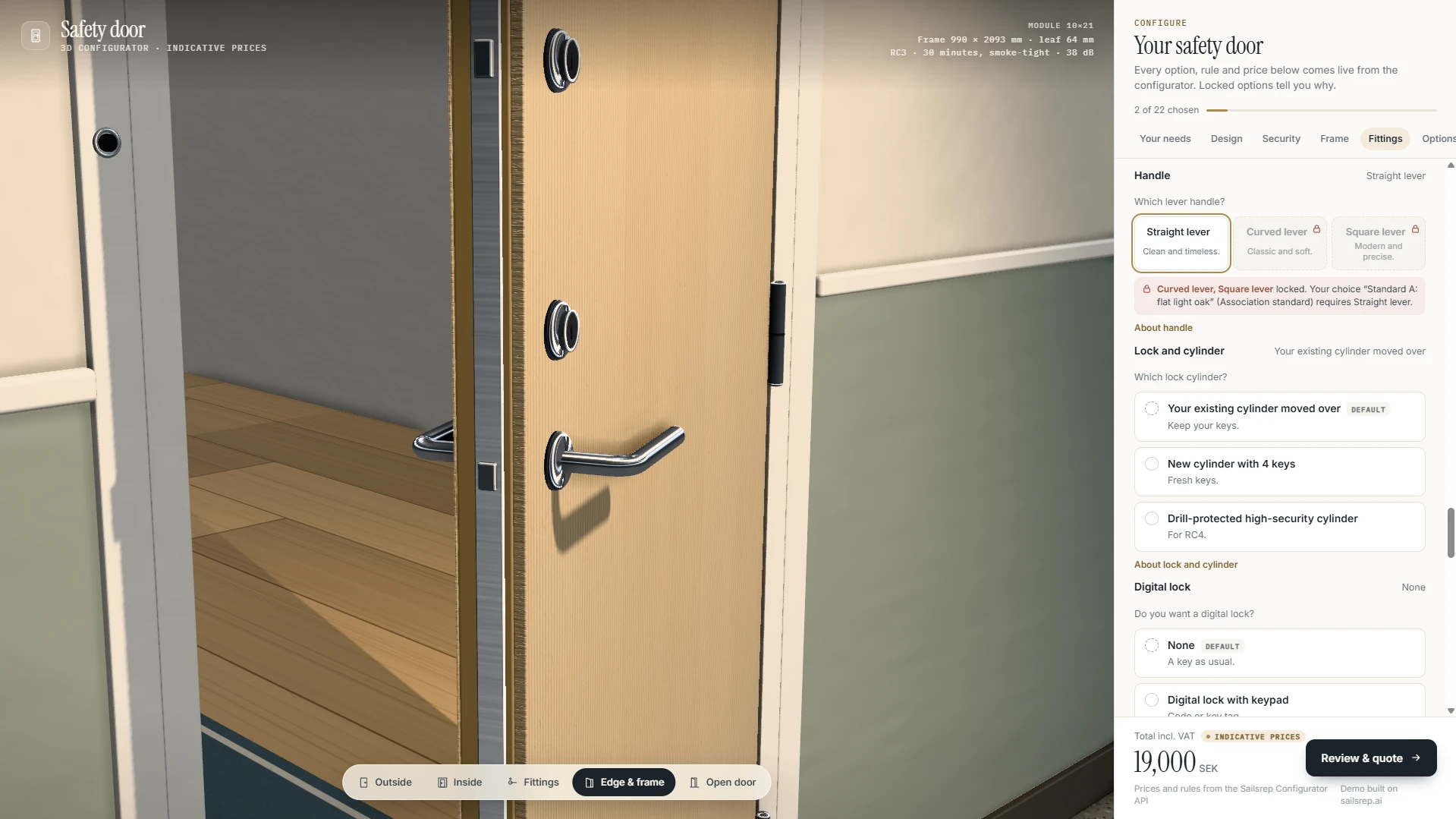
It is a real configurator with demo prices, and nothing is ordered. We open a different product every day, every other day in 3D, on our demo page.
What happens behind it?
We model your product with you: the choices, the rules between them and the prices. The idea is to cover the decisions behind most of your normal quotes, not to enumerate every variant on day one.
When a product changes, you tell the assistant. It proposes the change to the model and shows you every change before you accept it, and the solver checks the result. That is why a sailsrep.ai model does not need a half-time modeller to stay alive, the way a traditional CPQ model does.
Underneath, sailsrep.ai works with the major language models rather than training its own, so it improves as they do. The product rules stay in a constraint solver, where they can be read and checked.
Does it work in practice?
Two customers, told as they actually stand.
SWIFT Home Lifts already had a classic web configurator. They replaced it with a sailsrep.ai assistant running on their real product rules, and went live in about two weeks on roughly 40 hours of work. During the Sweden launch, quote requests went from about two a week to about twenty. A marketing campaign brought the traffic; the assistant is what made it convert. Anders Carlsson at SWIFT says it in that order:
"The campaign brought significantly more traffic to our website. The new solution then helped prospective lift customers take the next step, create an initial proposal, and ask to be contacted by a SWIFT salesperson."
HMF Cranes already had a CPQ: the Tacton model we built with them. Dealers are not crane experts, so HMF added a sailsrep.ai layer on top of that CPQ, their Microsoft Dynamics 365 CRM and their PIM. Nothing was replaced. Six weeks after a two-day workshop, the flow from conversation to dealer quote to priced proposal was running in internal testing with the export sales team, ahead of the dealer rollout.
"The data comes from our own systems, and the constraints control what can be built. That safe frame has been a big thing in this project."
What does sailsrep.ai cost?
From €990 a month, billed annually, with 500 quotes a year included and no limit on the number of products. Seats are only for people who log in to sell: buyers using the configurator on your website, and anyone viewing a proposal, need none. There is no implementation project of several months in front of it, and no half-time modeller behind it.
Isn't Tacton doing the same thing?
Partly, and we think that is good news. At Tacton Summit 2026, Tacton presented an AI sales assistant that reads a tender, extracts the requirements and maps them onto an existing Tacton model. Generative AI does the matching, the model's rules do the validation, and the assistant cannot invent anything the model does not contain. Every decision points back to the part of the tender it came from, requirements that cannot be met are listed, and the seller stays in control.
That is the principle sailsrep.ai is built on too: the model is the source of truth, and the AI can only choose what the model allows. When an established CPQ vendor and a newcomer arrive at the same architecture, the architecture is probably right.
The difference is the job:
- Tacton's assistant works behind the seller. It turns a long tender into a valid configuration inside an existing Tacton installation, with the evidence a bid team needs.
- sailsrep.ai works in front of the buyer. It holds the conversation on your website, with your dealers or with a rep in the field, and it does not need a CPQ underneath.
The two can run on the same model: at HMF, sailsrep.ai sits on top of the Tacton CPQ we built with them. If your sales start with tenders and you run Tacton, ask us about Tacton's assistant. If they start with a buyer who wants an answer tonight, that is sailsrep.ai.
When is sailsrep.ai the right choice, and when is Tacton?
We implement both, so we have no reason to push you toward either.
| sailsrep.ai | Traditional CPQ such as Tacton | |
|---|---|---|
| Time to go-live | Weeks (SWIFT: about two) | 4 to 5 months for one product family |
| Cost to start | From €990 a month, billed annually | Per-user licences plus an implementation of roughly €40k to €100k |
| Upkeep after go-live | No half-time modeller needed | About 0.5 FTE a year |
| Where the AI works | In front of the buyer: website, dealers, reps in the field | Behind the seller: Tacton's assistant turns tenders into configurations |
| Best fit | Correct quotes on the website and for dealers, no CPQ today, or a layer on an existing CPQ | Configuration spanning engineering, manufacturing and service across many product lines |
sailsrep.ai is built for manufacturers who want correct quotes without a year-long CPQ project. If your configuration spans engineering, manufacturing and service across dozens of product lines, an enterprise CPQ such as Tacton may serve you better, and we will say so. Our Tacton CPQ consultants page covers what that kind of project involves.
Is it secure?
sailsrep.ai is ISO 27001 certified under SWEDAC accreditation and GDPR compliant. Data is hosted in the EU, and the language models it uses run in the EU.
Want to see it on your own product? Book a meeting and bring one product family. We will tell you in that meeting whether sailsrep.ai, Tacton or neither is the right answer.
Full disclosure: cpq.se is a Tacton reseller and implementation partner for small and mid-sized manufacturers, and a CPQ advisor to enterprise organisations. We work with sailsrep.ai, and our co-founder Magnus Fasth works there.